TT Epaper LHS
The Telegraph
TT Mobile
 
 
IN TODAY'S PAPER
CITY NEWSLINES
 
 
ARCHIVES
Since 1st March, 1999
 
THE TELEGRAPH
 
CIMA Gallary
 
Email This PagePrint This Page
A GAME OF WITS
- The bonhomie with the BSP in UP will allow the BJP elbow room

The author is an independent researcher and political analyst

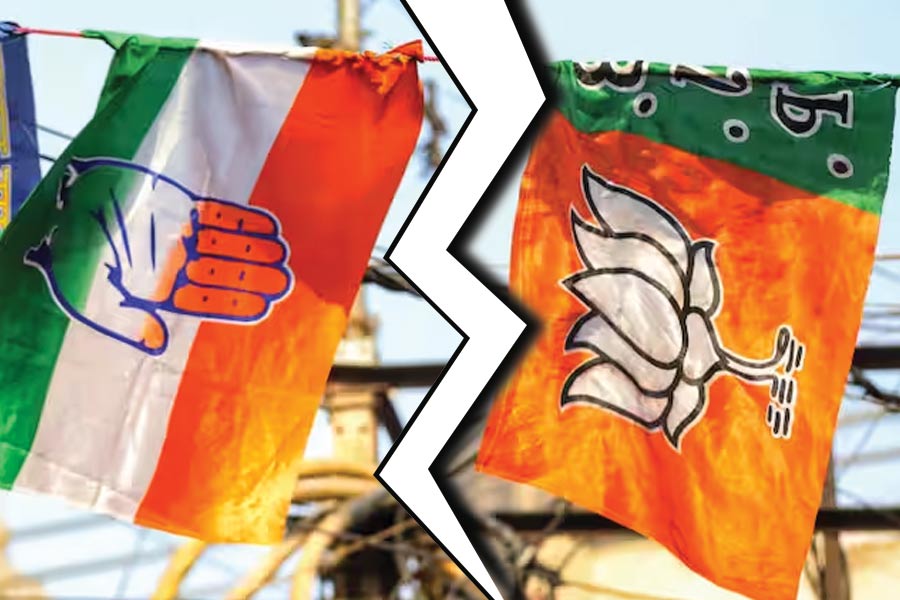
There is a meeting of minds of the two key figures in the ruling coalitions in Delhi and Lucknow. This is the central message driven home by the mass rally in the capital of Uttar Pradesh where L.K. Advani and Mayavati joined forces. The former even went so far as to claim that the rally was a sign of a mass movement cutting across conventional divides in society. But it is still too early to say whether the meeting of minds will be followed by a genuine unity down the line.

The Union home minister did have a point. In the post-Babri Masjid phase, no large autonomous lower caste party in the Hindi belt gave the hero of rath yatra politics such an impressive platform. If the UP government’s foot- dragging on the Ayodhya case and its plea against a special bench was the cake, the rally was the icing. One marked a deal, the other a very public espousal of a new bonhomie of two very distinct political movements.

For Mayavati, her alliance with the Bharatiya Janata Party reinforced her own position of dominance on home turf. The gathering was to all intents and purposes a Bahujan Samaj Party affair. She even vetted which leaders from the national party would sit on the dais and address the crowd. No upper caste leader who has the base to challenge her was present.

The acceptance of subordinate status by the saffron party was underscored in several ways. Rajnath Singh, former chief minister and state unit chief was pointedly absent. Those present included Vinay Katiyar (other backward classes), Lalji Tandon (Khatri) and Kalraj Mishra (Brahmin). The one savarna group that could stand its ground against Dalit assertion in the rural hinterland was sidelined. Others who require access to statist largesse were encouraged. The leader with roots in the Ram temple movement, Katiyar, now party president in UP, finds his plans to battle the chief minister hostage to the larger objectives of his own party.

Why the BJP needs Mayavati is clear enough. At one stroke, she silences many sets of detractors. Critics who charge it with being an upper caste warhorse in disguise have to explain why the country’s prime Dalit party teams up with it. Ambedkar becomes a symbol of the unity of the forwards and the Dalits versus the assertive and rising backward classes.

On a different plane, Advani gets a seal of approval he still needs after his central role in the movement for a Ram temple. Unlike Vajpayee who stayed aloof, he built his whole strategy to capture the political space by championing explicit, unapologetic Hindutva. Now, as he back-pedals in the wake of Gujarat, and projects a reasonable image, such a friend can be a big help.

Whether the bonhomie at the top can be replicated below is not so easy to foretell. There are as many points of friction as convergence. They do point to the possibility of an accord, mainly as both feel threatened by an alliance led by the OBCs, especially the Yadavs. But this does not guarantee a stable relationship.

The contrasts in the base of support are very striking. As recently as 1999, in the general elections, the BJP attracted only 16 per cent of the scheduled caste voters nationwide. Conversely it cornered nearly four-fifths of the Rajput and Brahmin votes in the state of UP. Saffron is weaker at the base of the social pyramid and much stronger at the apex.

The same set of post-poll surveys by the Centre for Study of Developing Societies shows the BSP heavily dependent on the lower strata of society. Not only has it retained a huge bloc of Dalit voters, it has been able to pull in important segments of others, notably lower OBCs and Muslims.

The confidence exuded by the BSP has a rational basis. It is the only party in the state that expanded its voter base so markedly in recent times. While there has been much turbulence and repeated change of tactics among the BJP leadership, the Dalit party has had steady hands at the helm.

Advani’s appearance on the stage with Mayavati confirms this. It may even mark the beginning of the end of its aspirations to hegemony in the state. The Congress underwent a similar transformation in its ties with the Dravidian parties in Tamil Nadu in the Seventies. From a dominant party, it was reduced to a marginal force. It had to court regional satraps to ensure that its tally of seats in the Lok Sabha remained respectable.

But the consequences of such a change in the north will be nothing short of seismic. It would be a stepping stone for the BSP to be more assertive not only in the state but in the country at large. It would also mean a slow eclipse of the power of the saffron party as it cedes influence on the ground. Already, Mayavati seems to tower over her counterparts in the state unit of the BJP. By standing alongside a national leader, and one increasingly seen as the driving force in the National Democratic Alliance and the BJP, it is she who stands to gain the most. The failure to break the bonds of caste in north India would be the single most significant outcome of the Nineties. Caste has been transformed from a means to hold down the lower social orders into a building block for new alliances led by those who rise from their ranks.

Hindutva did recruit a huge lower caste base, but it failed to reward its leaders from such sections adequately. Kalyan Singh’s bid to Mandalize the movement came to naught. Rajnath Singh attempted to divide the backwards and the Dalits in a scheme that turned out to be a non-starter. Unlike in western India, the inter-community bonds of dependence seem too real to make religion an adequate binding force for a community of politics in the long term.

It is equally important that the main critic on the ground has been a Yadav, Mulayam Singh, who has set aside the rural centred politics of his mentor Charan Singh. He is now trying to craft an alliance with sections of the upper castes, while holding onto his OBC and minority base. In the future, this will enable him to reach out to other forces but on the condition they endorse his leadership in the state. The saffron party is worried by the very real possibility that it may be reduced to a bystander as new forces take the game out of its reach. Hence, its repeated readiness to sup with Mayavati. Unlike in the past, it can neither break her party nor expel her from power. Being in power in New Delhi has in fact made it even more reliant on a friendly ally in the only large Hindi belt province where it shares power. The new equation will buy Advani’s party breathing space and elbow room. That is the immediate aim.

Top
Email This PagePrint This Page