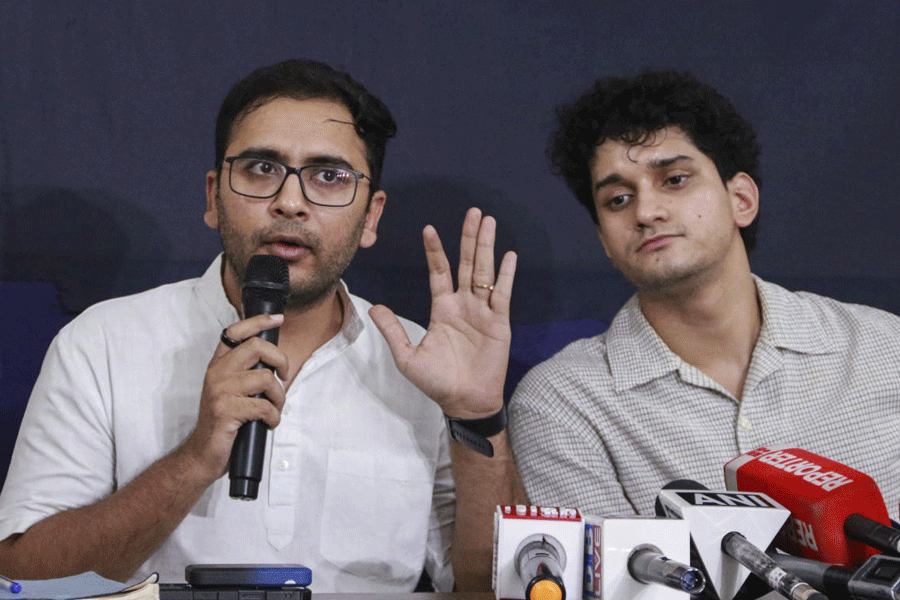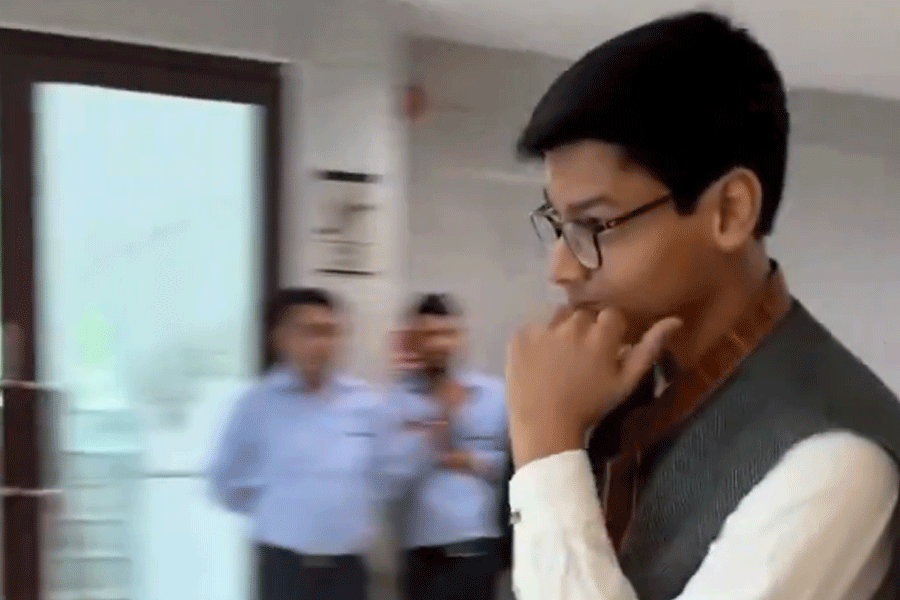
Sarthak Sidhant, one of the students affected by the Central Board of Secondary Education's (CBSE) On-Screen Marking (OSM) system, appeared before a Parliamentary panel on Tuesday and presented his findings on the alleged irregularities in the OSM tendering process.
The meeting, held at the Parliament House Annexe, comes amid growing concerns over alleged technical glitches, discrepancies in evaluation and challenges faced by students during the post-result verification process.
The committee on education, women, children, youth and sports was reviewing the use of OSM in Class 12 CBSE examinations and examining concerns related to transparency and accountability in the assessment process.
According to sources, Sidhant made a presentation before the panel and submitted a seven-page document detailing his findings. The presentation was made in the presence of CBSE Chairman Rahul Singh, Secretary of the Department of School Education and Literacy Sanjay Kumar, and other officials from the Ministry of Education and the board.
Sidhant pointed out what he described as anomalies in the CBSE's tendering process for selecting vendors for online marking and placed a set of questions before the board.
Sidhant had earlier alleged that a comparison of multiple CBSE tender documents revealed several discrepancies that, according to him, appeared to favour a particular service provider.
Speaking to ANI before the meeting, he said, "There were many discrepancies. I have just compared them. There were at least 15 discrepancies as per my blog. I would like to highlight three or four of them."
Sidhant, in his blog, pointed to changes in tender conditions governing the OSM system and claimed that clauses related to poor performance, blacklisting, financial qualification limits, CMMI levels and project eligibility criteria were altered across successive tenders.
"The first discrepancy is that in the old tender, there were three clauses of poor performance, that the service provider would be disqualified if they have poor performance. But in the new RFP, it was totally wiped out," he alleged in his blog.
The student said his research was undertaken in collaboration with ethical hacker Nisarg Adhikari and journalists investigating the issue.
He has maintained that he is not opposed to the OSM system itself but believes it required more extensive testing before implementation.
"I think OSM is a good change, but there should be wide rollouts first and good demo pilots," he said.
The Parliamentary Standing Committee had summoned Secretary, Department of School Education and Literacy, Sanjay Kumar, and CBSE Chairman Rahul Singh to brief members on the implementation of the OSM system and the issues reported by students.
According to sources, the CBSE submitted a report to the committee presenting its position on the concerns raised by students and informed members that the glitches reported on its portal had been rectified. The board also said students would have time until June 6 to apply for re-evaluation of their answer sheets.
The panel also heard first-hand accounts from students affected by the system. Committee chairman Digvijaya Singh later told reporters that Sidhant had made a presentation before the panel.
Asked whether he was satisfied with the CBSE's responses, Singh said, "That is for the committee to decide."
The Parliamentary Standing Committee had also called the director general of the Indian Computer Emergency Response Team (CERT-In), signalling that members may examine the technological and cybersecurity aspects of the controversy, including concerns related to system glitches, data integrity and the robustness of the digital evaluation infrastructure.
Headed by Congress MP Digvijaya Singh, the committee is expected to assess whether the transition to technology-driven evaluation systems has been implemented effectively and whether adequate safeguards are in place to protect students' interests.
Apart from the OSM issue, the committee also discussed the implementation of the three-language formula in Classes 9 and 10 with education ministry officials. When asked about the issue, Singh declined to comment, saying, "I believe the matter is sub-judice."
The panel is one of Parliament's 24 standing committees. Comprising 31 members—21 from the Lok Sabha and 10 from the Rajya Sabha—it is nominated by the Speaker of the Lok Sabha and the Chairman of the Rajya Sabha, with members serving a one-year term.
The committee examines legislation, budgetary allocations, policy matters and specific issues.