
Picture by Mayukh Sengupta
SHEFALI MONDAL
Age: 50
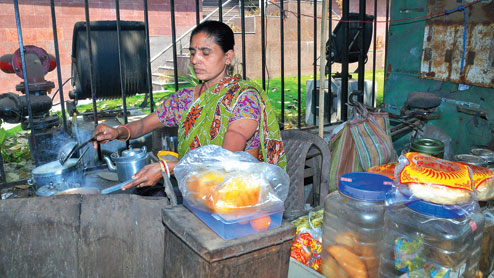
Profession: Runs a tea stall on the footpath of Bhel Bhaban, near Karunamoyee
Her story: It’s been 30 years since Shefali landed in Calcutta as a refugee from Bangladesh. She had crossed the border by chance. “Ami toh khelte khelte chole elam e deshe (I came to this country while playing),” she smiles.
“My parents have been dead for as long as I can remember. I was living with relatives who did not care for me. I used to spend all day at my friend’s house in our village near Faridpur. One day we were playing when her parents called us and said they were going to India to start a new life. Without thinking twice, I said I too wanted to go with them. My friend’s mother agreed and I came to India along with them. I was five years old then,” she recalls.
Once in Calcutta, she found work as a domestic help in Barasat. But salary was irregular and she moved on to another household in Madhyamgram. She lived with that family for 12 years as a domestic help. “My employers then got me married to an Oriya man who was a group D staffer at their office. My husband and I set up this tea stall near Bhel Bhaban and this has been our source of income for the last 14 years,” she added.
She has a son and three daughters. But husband is a drunkard. “He comes to the stall in the evening and takes away all my money. I hide it in tea packets when I know it is time for him to come. I run the stall all by myself. Sometimes my son helps. I have bought a small plot of land in Basirhat and built a house there. My children go to government schools. I hope to build a bright future for them,” she added.
She believes only in hard work. “I have worked hard all my life. I feel if you do your work with honesty, things will look up sooner or later. Hard work always pays good dividends.”
On Women’s Day: “I have heard people talking about it while having tea in my stall. As a woman, I want safety from my husband. He beats me when there is no money in the cash box. I want my daughters to get good jobs. My son is lazy, just like his father. But my daughters are my hope. I want to see them doing well,” she said.

TULIKA MONDAL
Age: 38
Profession: Runs a tailoring shop in Bangur Avenue
Her story: Tulika used to be a docile housewife for most of her life. She lived a simple life with her husband and daughter. But destiny had other plans. Her husband passed away suddenly in 2014 and she was left penniless. “My daughter was then in high school and we were left all alone. There was no one to look after us. We had a small tailoring shop that he used to run. But I had no training in cutting and stitching. I realised I had no option but to pick up the business from where he had left off. I enrolled for a course and learnt the skills for a whole year. I then reopened our shop,” she said.
Running a business single-handedly is demanding. “You have to be very focussed and aware of people constantly trying to pull you down,” she points out.
But it has been worth her while. “My family is stable again. My daughter is going to college and is studying computer science. We have a steady income now,” she added.
So what was the first thing she learnt as a working woman? “That you have to be nice to people. All our old customers started coming back once we reopened the shop. They thanked me for picking up the business and always ask about our welfare. That is something really nice. Also, as a woman I feel it is important to step out of your comfort zone. It helps you grow as an individual,” she adds.
On Women’s Day: “As a woman, I think we are stuck in a glass box. We need to break out of that. I also feel the need to spread awareness about women’s issues,” she says.

SADHNA SORAN
Age: 43
Profession: Works as an ayah for Care Ayah Centre in Ultadanga. Has worked in several homes in Salt Lake.
Her story: Sadhna wakes up at 4 every morning. She then cooks, cleans and washes for her four daughters. She then gets ready, wakes her daughters up and leaves to catch the 6am train from Kankinara station, near Naihati. She gets off at Bidhannagar Road station and reports for work at 7.30am. “I am deputed by the ayah centre mostly to work in households of Salt Lake. I have worked in FD Block and BD Block. I look after the ailing, often bed-ridden, senior citizens. In most homes, everyone else steps out to work. I stay with the elderly, cook for them, bathe them, clean their bedpans, give them medicines. My shift lasts from 8am to 7pm. I usually get paid Rs 300 for 11 hours,” she says.
All her four daughters go to school. The oldest one is 22 while the youngest is 15. Her dream is to establish them in good jobs. “I don’t know what kind of husbands they will find. My husband died eight years ago. I have been working as an ayah ever since to run the family. I want them to be independent women — may be become teachers in schools or work in offices. The rest is destiny,” she said.
On Women’s Day: “As a woman, I want to be treated with respect. I may be cleaning bedpans for a living but that does not mean that I am not a human being. It is just a job that I do. I want people to remember that,” she says.

PAUSHALI GANGULY
Age: 38
Profession: Assistant Sub-inspector, Bidhannagar South police station
Her story: A single mother, Paushali’s son was only nine months old when her husband passed away in 2006. Today her son is 11 years old.
As a child, she was always fascinated by the uniform. It drew her to the profession. “I have been a national level kabadi player and that is how I landed this job. But my husband was from a different profession. He worked as a medical representative. I deliberately married someone outside my profession because I wanted to look at life from a different outlook when it came to marriage,” she said.
Did the tag of police bou ever bother her? “Yes it did. My in-laws were from Jalpaiguri. Everyone used to call me ‘police bouma’ or ‘police boudi’. Even today, the tag has stuck. You kind of get used to it,” she added.
Being in a profession perceived as masculine, adjusting to the expectations of submissive domesticity was not easy. “At my in-laws’, a daughter-in-law has to wear a ghumta. And there I was, I was stepping out in uniform (khaki shirt and trousers). It was awkward. There were days when I wore a sari over my uniform while stepping out in the morning for the master parade at 6am and then taking off the sari once I was out of the gate of our house. But my father-in-law was very supportive. Which is why I didn’t face any problems,” she recalled.
When it comes to handling unruly crowds, she says she doesn’t face problems because her male colleagues are always at hand to help. Also, she leads the group only if there is a women’s gathering.
Her day begins with getting her son ready for school, picking up vegetables and groceries from the market after dropping him off to school, cooking breakfast and eating it with her parents. She then cooks lunch and leaves for office at 10am.
She cannot make it back home before 11.30pm. “I have grown used to this routine. My life is different but interesting. I love what I do,” she smiles.
On Women’s Day: “This is a nice occasion to celebrate the changing status of women in our society. I like the way women are felicitated in various programmes on this day.”
Pictures by Mayukh Sengupta